
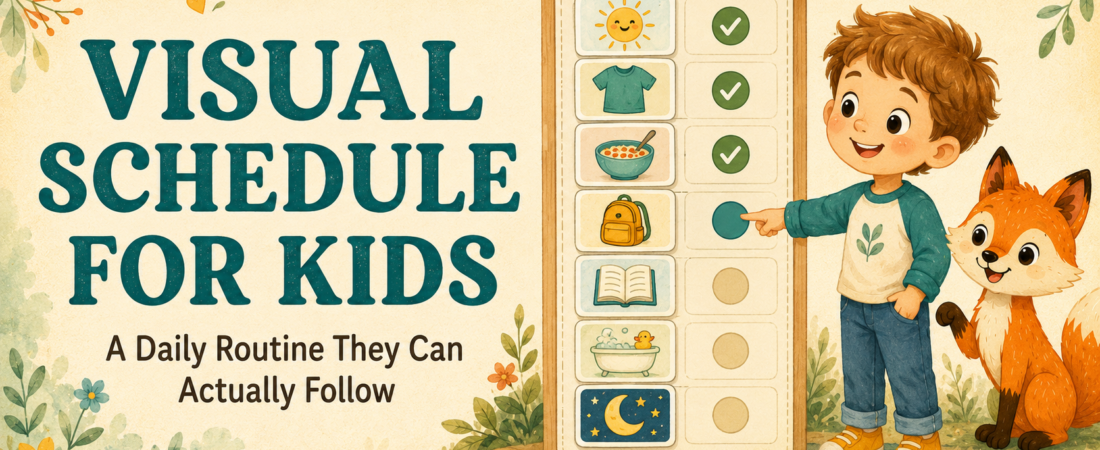
Visual Schedule for Kids: How to Create a Daily Routine They Can Actually Follow
It is a scene played out in millions of households every single morning: a parent standing at the bottom of the stairs, repeating the same sequence of instructions for the fifth time. “Put on your shoes. Get your backpack. Did you brush your teeth yet? No, do not touch that toy, we are leaving in two minutes!”
Despite your loudest reminders, your child stands frozen, distracted by a stray LEGO brick, or completely overwhelmed by the verbal demands being thrown their way. By the time everyone finally buckles into the car, stress levels are through the roof, and the day hasn’t even officially started.
When daily life feels like a never-ending series of power struggles, micro-management, and repeated instructions, it is easy to assume your child is simply being defiant. However, the root cause is often much simpler: executive dysfunction and cognitive overload. Young minds struggle to process, sequence, and retain abstract verbal instructions. When you tell a child to “get ready for school,” their brain has to decode what that means, organize the physical steps, resist immediate distractions, and execute the tasks in order.
The secret to breaking this exhausting cycle isn’t raising your voice—it is changing how you communicate. By shifting from verbal reminders to a clear visual schedule for kids, you transform abstract, invisible expectations into a concrete roadmap they can see, touch, and independently master.
What is a Visual Schedule (and Why Does It Work)?
At its core, a visual routine chart for kids is a physical tool that uses images, icons, or simple photographs to display a sequence of events or tasks in the exact order they will occur. Instead of relying on a parent to act as a walking, talking alarm clock, the child looks at their chart to discover what is happening now and what will happen next.
According to research from the National Center for Pyramid Model Innovations, structural visual resources are highly effective clinical tools used to explicitly show children what is happening in the present moment and what will follow immediately after. By providing this visual clarity, these tools actively support predictable routines, lower anxiety, and ease difficult transitions between activities.
When a child can physically look at a picture schedule for kids and see a drawing of a cereal bowl followed by a toothbrush and a backpack, the abstract concept of “morning time” suddenly becomes clear. It removes the mystery of the day, reduces the cognitive friction of transitions, and gives children a profound sense of environmental control.
The Neurological Advantage of Images
Why can’t we just write down a checklist or tell them what to do? The answer lies in early childhood neurodevelopment. The human brain processes visual information significantly faster than written or spoken language. For young children who are still learning to read, verbal instructions exist only for a fleeting second before vanishing from their short-term working memory. If a child gets distracted mid-task, the verbal instruction is completely gone.
A visual icon, however, is permanent. It does not disappear when a toy catches their eye. When a child looks up, the picture of their shoes is still there, quietly and neutrally reminding them of the next step without any parental nagging. Images allow pre-readers to decode their entire day with absolute autonomy, bypass language processing barriers, and build internal patterns of self-regulation.
For Which Ages Does a Visual Routine Work?
One of the greatest misconceptions about visual toolkits is that they are exclusively meant for toddlers or children with neurodivergent diagnoses like ADHD or Autism. While they are incredibly transformative for those groups, visual structures are universally beneficial across multiple developmental stages:
- Toddlers (Ages 2–3): At this stage, children are exploring independence but lack a conceptual understanding of time. A very simple daily visual schedule for kids consisting of two or three high-contrast pictures (e.g., Eat Lunch → Nap Time) helps stabilize their emotional world and dramatically reduces transition tantrums.
- Preschoolers & Kindergartners (Ages 4–6): This is the sweet spot for a comprehensive kids daily routine chart. Children at this age thrive on clear order and take immense pride in checking off tasks independently. They can comfortably manage a sequence of 4 to 6 consecutive morning or evening tasks.
- Early Elementary (Ages 7–9): As children master reading, the schedule can evolve into a hybrid of text and icons. At this stage, the chart expands beyond personal hygiene to help them track homework windows, music practice, sports practices, and household chores.
Decoupling the Calendar, Routine, and Checklist
To build a system that genuinely works, you must understand the structural differences between the three main types of organizational tools. Mixing them together into a chaotic jumble is the number one reason charts end up abandoned in the trash.
+-------------------------------------------------------------------+
|                        MY EASY WEEK SYSTEM                        |
+-------------------------------------------------------------------+
|  1. THE WEEKLY CALENDAR      --> Big picture events & sports      |
|  2. THE DAILY VISUAL ROUTINE --> Step-by-step sequential flows    |
|  3. THE CHORE CHECKLIST      --> Non-sequential task completion   |
+-------------------------------------------------------------------+
1. The Weekly Calendar
The weekly calendar provides a macro-view of the family’s life. It answers big-picture questions like: What day do I have soccer? When do we visit Grandma? Is it a school day? It is not meant to show micro-movements like brushing teeth; it is designed to ground the child within the larger framework of their week.
2. The Daily Visual Routine
This is a micro-sequenced flow chart. It is highly tactical and shows the exact chronological steps required to complete a specific block of time, such as waking up or winding down for bed. It relies heavily on the “First/Then” neurological framework (First brush teeth, then put on shoes).
3. The Checklist
A checklist is a non-sequential collection of tasks that can be completed in any order within a specific window. Cleaning a bedroom or packing a school bag fits perfectly into a checklist format, where the sequence matters less than the final completion.
Step-by-Step Guide: How to Create a Visual Schedule Your Child Will Actually Use
Now that you understand the underlying psychology, let’s build a functional, step-by-step visual schedule at home that matches the rhythm of your unique household.
Step 1: Audit and Choose Only the Essential Activities
The temptation to visualize every single action—from waking up to drinking water—is a recipe for failure. A chart crowded with twenty micro-tasks creates visual clutter and causes children to tune out completely.
Focus exclusively on the friction points in your day. If your child already puts on their clothes without being asked, they do not need an icon for it. Keep the routine restricted to 4 to 6 essential anchor steps per block. A clean, streamlined sequence is far easier for a young brain to process and execute.
Step 2: Involve Your Child in the Design Process
If you design the chart in secret and present it as a set of mandatory new rules, your child will likely resist it. Psychological ownership is crucial for long-term compliance.
Sit down together during a calm afternoon. Let them help choose the images, color-code the blocks, or take pictures of them performing the actual tasks (e.g., a photo of them physically brushing their teeth). When a child feels like they helped create the system, they will actively work to defend it.
Step 3: Choose the Ideal Physical Location
A schedule hidden away in a hallway or tucked inside a cabinet is useless. The chart must live exactly where the actions take place.
- The Morning Routine Chart: Place it directly in the bathroom mirror or right beside their bedroom door where they change out of pajamas.
- The After-School/Evening Chart: Position it at eye-level near the entryway where backpacks are dropped, or prominently on the refrigerator door.
🚀 Create an Easy-to-Follow Week for Your Child
Ready to eliminate the daily nagging without spending hours cutting, laminating, and printing paper cards? Discover My Easy Week, the ultimate premium visual system designed specifically for families. Featuring beautiful, durable, and highly intuitive magnetic icons, My Easy Week gives your child a clear, interactive visual path through their day, turning chaotic power struggles into independent family success. Get your My Easy Week system today and restore peace to your home!
Real-World Examples: Morning and After-School Visual Templates
To help you get started, here are two optimized structural templates designed to streamline the most common daily friction points.
The Ideal Pre-School Morning Routine
This sequence is built around clear, chronological progression, moving smoothly from their bedroom to the bathroom and finally to the kitchen or front door.
[ Wake Up & Make Bed ] ---> [ Change into Clothes ] ---> [ Eat Breakfast ]
                                                               |
                                                               v
[ Grab Coat & Backpack ] <--- [ Put On Shoes ] <--- [ Brush Teeth & Hair ]
- Parent Strategy: If your child struggles with getting distracted by toys after eating breakfast, ensure the Brush Teeth and Put On Shoes icons are physically separated from the bedroom play space.
The Balanced After-School Routine
The block of time immediately following school requires a careful mix of essential responsibilities and intentional neurological decompression.
[ Drop Bag & Hang Coat ] ---> [ Wash Hands & Eat Snack ] ---> [ Homework / Reading ]
                                                                     |
                                                                     v
[ Free Playtime Window ] <--- [ Pick Up Toys / Ready for Bed ] <--- [ Family Dinner ]
- Parent Strategy: Always place a high-value anchor like Free Playtime or Outdoor Fun immediately after a lower-dopamine task like Homework. This builds an internal motivation loop based on Premack’s Principle: harder tasks become easier to start when a guaranteed reward follows.
Handling the Unexpected: How to Indicate Routine Changes
Life is unpredictable. School gets canceled, doctor appointments pop up, playdates are scheduled, and rainy weather cancels outdoor sports. A common mistake parents make is maintaining a rigid chart that doesn’t adapt, which causes children to panic when real-life events don’t match the visual icons.
You need a simple, consistent method to signal changes without tearing down the entire routine:
- The “Special Event” Magnet or Card: Keep a dedicated, bright exclamation point or “Change of Plans” icon handy. Place this card directly over the standard activity slot to visually indicate an exception.
- The Cross-Out Technique: If you use a dry-erase surface, draw a clean, single line through the canceled activity together with your child, and sketch a quick icon of the new destination next to it.
- Morning Briefings: If you know the day’s schedule will look different, preview the changes on the board during breakfast. Say: “Look right here. Today, instead of going to the park after school, we have a doctor’s visit. Let’s place the doctor icon here together so we don’t forget.” This simple step completely eliminates the anxiety of surprise transitions.
4 Common Mistakes That Make Kids Ignore Their Charts
If you have tried using a daily schedule in the past and found it abandoned within a week, you likely fell victim to one of these common structural pitfalls:
1. The Schedule is Far Too Complicated
Including minor actions like “wipe your face,” “put on socks,” and “say good morning” creates severe visual fatigue. The child gets overwhelmed looking at the board and stops checking it entirely. Keep it limited to the core anchor tasks.
2. You Transform the System Into a Nagging Tool
If your child is standing still and you yell across the room, “Go look at your board! Why haven’t you checked your board yet?”, you have completely missed the goal. The chart should replace your voice, not amplify it. Instead of nagging, point silently to the board or ask a neutral, open-ended question: “What does the board say is next?” This subtle shift trains them to look to the schedule for direction rather than relying on you.
3. Total Lack of Consistency
If the board is updated diligently for three days, ignored for four days, and then brought back randomly when you are feeling stressed, children learn that the system isn’t permanent. For a routine to become automatic, it must remain fixed, visible, and consistently referenceable every single day.
4. Zero Interactive Feedback
Children thrive on tangible progress. If a chart is just a static piece of paper taped to a wall, it quickly fades into the background like a poster. The system must be interactive. Whether they physically flip a card over, move a colorful magnet to a “Done” column, or slide a panel shut, the physical act of marking a task complete provides a rewarding hit of dopamine that encourages them to move on to the next step.
Frequently Asked Questions
What if my child completely refuses to follow the visual schedule?
Resistance usually happens when a tool feels like an arbitrary set of rules imposed from above. Involve your child in the reset process. Let them choose where the chart goes, customize the markers, or use a points-based incentive system where completing their visual blocks earns them a special weekend activity. Most importantly, stay calm and consistently direct them back to the board without adding emotional tension.
Should I offer rewards for completing the daily routine?
In the beginning, small incentives can help build momentum. However, avoid long-term material rewards for basic daily hygiene and habits. Instead, rely on natural privileges. For example, frame access to screen time or playtime as a natural consequence: “As soon as your morning visual block is moved to the ‘Done’ column, you are totally free to play until we leave.”
How long does it take for a visual routine to become an automatic habit?
On average, it takes between 21 to 30 days of consistent, uninterrupted daily repetition for a new sequence to form a deep neurological pathway. Expect to provide gentle guidance during the first two weeks. By week three, you will notice your child checking the board entirely on their own.
How do I transition an older child away from pictures?
As reading comprehension stabilizes around ages 7 or 8, you can naturally phase out cartoon drawings and replace them with simple text checklists, bullet journals, or integrated family apps. Let your child drive this transition—they will naturally tell you when they feel “too old” for icons and want to use a more grown-up checklist system.
The 7-Day Sanity Challenge
Building a peaceful home doesn’t happen overnight, but you can dramatically shift the dynamic of your household in less than a week. Commit to introducing a simple visual sequence this week. Stop the verbal repetition, involve your child in the setup, locate the chart exactly where the action happens, and let the icons handle the hard work. By replacing parental nagging with predictable visual clarity, you give your child the gift of independent confidence, reduce daily anxiety, and finally bring long-term peace back to your family’s daily routine.